Why Shopify Brands Are Doubling Down on Influencer Marketing
Discover why Shopify brands are investing more in influencer marketing, from rising ad costs to measurable ROI, attribution, and scalable growth strategies.
January 26, 2026
Over the past few years, Shopify brands have relied heavily on paid ads to drive growth. But rising customer acquisition costs, attribution challenges, and platform dependency are forcing ecommerce teams to rethink their go-to-market strategies.
As a result, influencer marketing for Shopify brands is no longer treated as an experimental channel. Instead, more brands are doubling down on it as a scalable, performance-driven growth engine.
Here’s why.
The Shift: Why Paid Ads Are Losing Efficiency for Shopify Brands
Paid acquisition is getting harder. CPMs continue to rise across Meta, Google, and TikTok, while conversion efficiency declines due to signal loss and increased competition. For many Shopify brands, paid ads have become less predictable and harder to scale profitably.
At the same time, consumers trust ads less, and trust people more.
This shift is pushing brands to look beyond short-term ad optimization and invest in channels that compound over time. That’s where Shopify influencer marketing is gaining momentum.
Influencer Marketing as a Performance Channel, Not Just Awareness
Historically, influencer marketing was viewed as a top-of-funnel tactic. Today, that perception is changing fast.
Creators function as trust infrastructure for ecommerce brands. Their content drives discovery, consideration, and conversion, often in a single interaction. When paired with clear calls to action, trackable links, and promo codes, influencer marketing becomes measurable.
This evolution is why more brands now treat influencer marketing for ecommerce as a revenue channel, not just a branding play.
According to Forbes, influencer partnerships are increasingly used to scale businesses, not just generate buzz, especially when campaigns are structured around performance outcomes rather than vanity metrics.
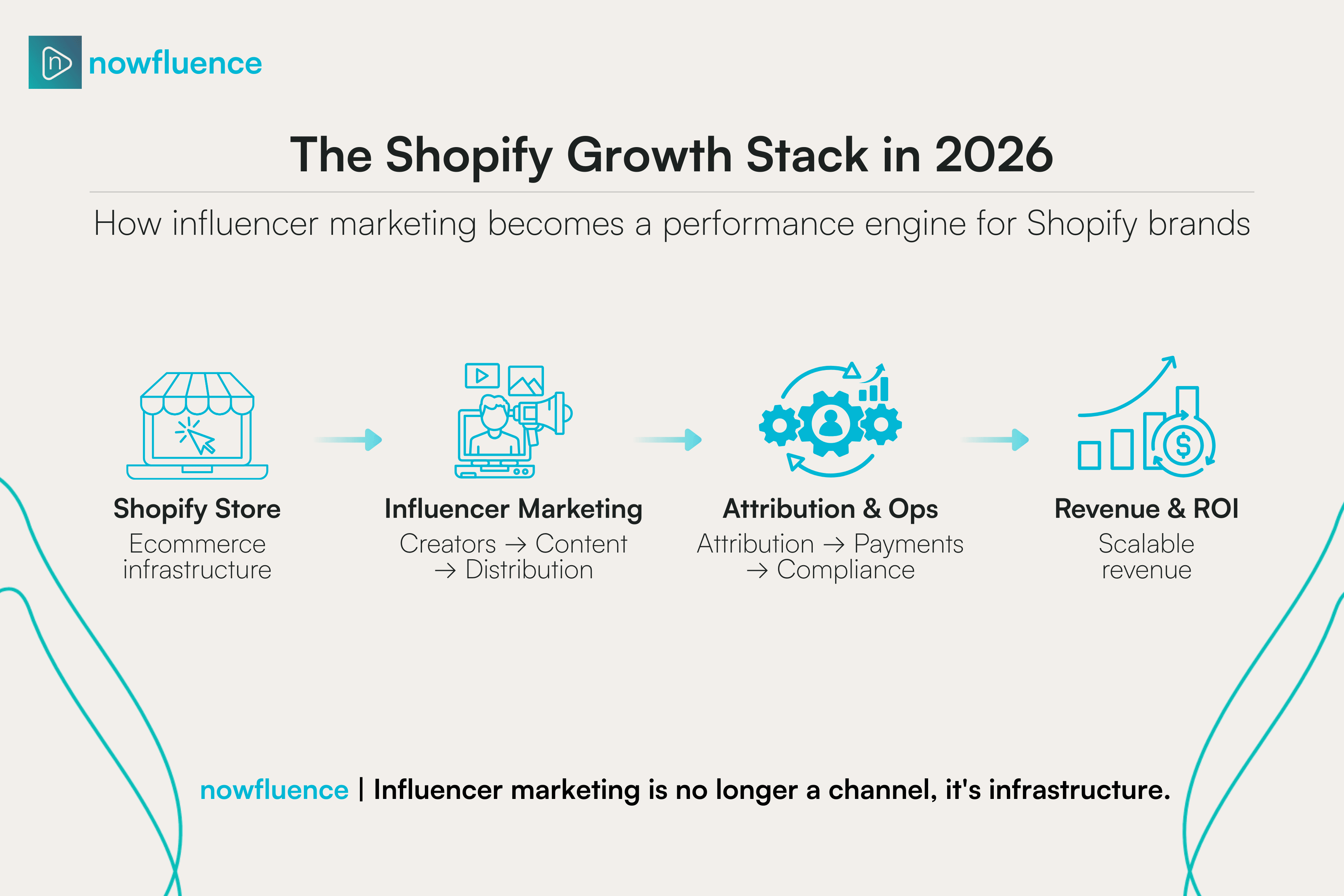
Why Shopify Is the Perfect Stack for Influencer-Led Growth
Shopify’s ecosystem makes it uniquely suited for influencer-driven strategies.
With fast storefronts, seamless checkout, and flexible integrations, Shopify brands can move quickly from creator content to conversion. When influencer campaigns are properly tracked, brands gain visibility into which creators are driving actual sales, not just engagement.
This is one of the key reasons influencer marketing ROI for Shopify has become a board-level conversation.
Shopify itself highlights that modern ecommerce growth is increasingly shaped by creator-led discovery and social commerce trends, reinforcing why brands are reallocating budgets toward influencer partnerships.
The Role of Attribution and ROI in Scaling Influencer Marketing
What’s enabling this shift isn’t just creators, it’s measurement.
As Shopify brands mature, they demand clarity around performance. That means moving away from last-click attribution and embracing models that reflect how consumers actually buy.
Accurate influencer attribution on Shopify allows brands to:
- Identify top-performing creators
- Optimize spend across campaigns
- Scale partnerships with confidence
Without attribution, influencer marketing stays small. With it, brands can invest aggressively.
Operational Maturity: Why Brands Are Investing More Now
Another major reason brands are doubling down is operational readiness.
Running influencer campaigns at scale used to mean spreadsheets, manual payouts, compliance risk, and endless coordination. That friction limited growth.
Today, brands are prioritizing influencer operations, streamlining workflows, approvals, and payments so teams can run campaigns continuously instead of sporadically.
This operational layer is what turns influencer marketing from a side project into a core growth function.
Why This Trend Is Accelerating in 2026
Looking ahead, this shift is only accelerating.
Marketing organizations are becoming more data-driven, insight-led, and performance-focused. According to the Canadian Marketing Association, teams that leverage insights to guide decision-making are better positioned to scale efficiently in 2026 and beyond.
For Shopify brands, influencer marketing fits perfectly into this future:
- It’s creator-native
- It aligns with how consumers discover products
- It becomes predictable when powered by data and attribution
Add AI-driven creator analysis, real-time performance tracking, and automated operations, that influencer marketing starts to look less like an experiment and more like infrastructure.
Final Thoughts: Influencer Marketing Is Becoming a Core Revenue Channel
Shopify brands aren’t doubling down on influencer marketing by accident.
They’re doing it because:
- Paid ads are harder to scale
- Consumers trust creators more than ads
- Attribution and ops have matured
- Performance is now measurable in real time
As influencer marketing becomes faster, more transparent, and more scalable, it’s increasingly positioned as a core revenue channel, not a marketing gamble.
For brands that want sustainable growth, the question is no longer if influencer marketing works, but how well it’s executed.
Want to discuss insights from this study? Reach out to our research team.