How Brands Scale Influencer Marketing Without Agencies
Learn how brands scale influencer marketing without agencies using AI, automation, and real attribution to turn creator partnerships into a measurable growth channel.
February 05, 2026
For years, influencer marketing agencies played an important role in helping brands enter the creator economy. They provided access, coordination, and execution when internal teams lacked the tools or experience to manage creators directly.
But as influencer marketing evolves into a recurring, performance-driven channel, many brands are running into the same limitation: the agency model does not scale.
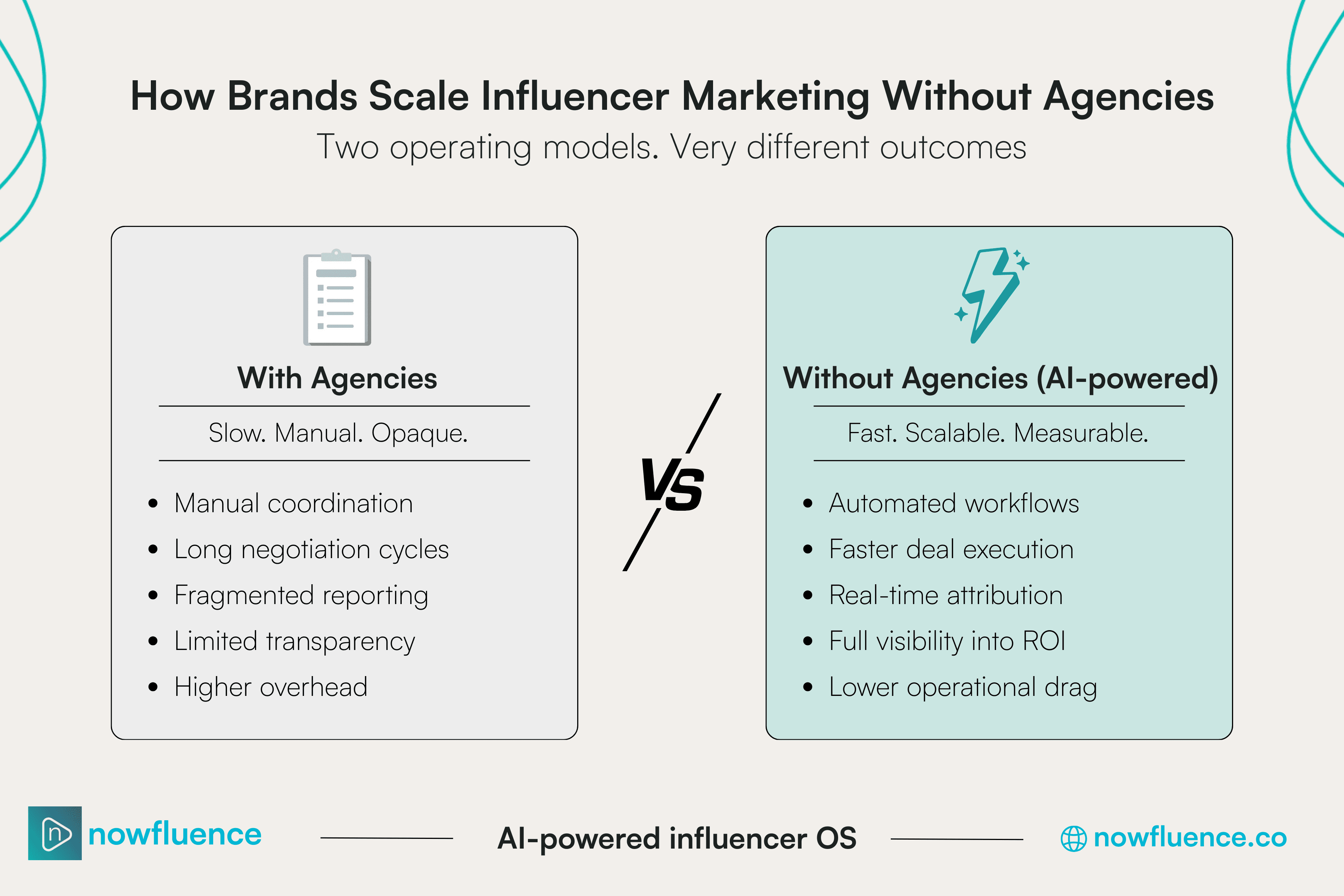
Agency workflows are inherently manual, expensive, and difficult to measure. As brands increase campaign volume, launch always-on programs, or expand across platforms like Instagram, TikTok, and YouTube, dependency on agencies often slows execution instead of accelerating growth.
Today, the fastest-growing brands are learning how to scale influencer marketing without agencies, by building in-house systems powered by automation, data, and AI.
Why the Agency Model Breaks at Scale
Agencies work well for one-off campaigns. They struggle when influencer marketing becomes a core growth channel.
At scale, brands typically face:
- High fixed retainers and variable fees tied to spend
- Slow creator discovery and outreach cycles
- Limited visibility into performance and ROI
- Fragmented data spread across reports, emails, and spreadsheets
More importantly, agencies insert distance between brands and creators, at a time when authentic relationships matter more than ever.
According to Forbes, modern marketing success is increasingly driven by an earned mindset, where trust is built through consistent value and genuine relationships, not outsourced execution or bought attention. When influencer relationships are mediated entirely by third parties, brands lose speed, insight, and long-term leverage.
At scale, influencer marketing requires systems, not intermediaries.
What Scaling Influencer Marketing Actually Requires
Scaling influencer marketing is not about signing more creators. It’s about building infrastructure that allows teams to operate efficiently, repeatedly, and predictably.
Creator Discovery at Scale
Manual creator sourcing does not work beyond a handful of campaigns. Brands need the ability to:
- Search across millions of creator profiles
- Analyze audience fit, content quality, and relevance
- Evaluate creators consistently, without relying on gut feeling
This is where AI-driven discovery becomes essential.
Faster Deal Execution Without Endless Negotiation
One of the biggest bottlenecks agencies create is negotiation friction.
Brands need:
- Clear expectations around deliverables
- Predictable pricing benchmarks
- Faster deal cycles that allow rapid testing and iteration
When rate expectations and creator data are visible upfront, brands can move from discovery to paid deals in days, not weeks.
Speed becomes a competitive advantage.
Real Attribution and ROI Visibility
Scaling influencer marketing without agencies only works if performance is measurable.
Brands running high-volume campaigns need:
- Revenue attribution per creator
- Visibility into what actually drives sales
- Reporting that connects influencer spend to business outcomes
This is especially critical for Shopify brands, where influencer marketing increasingly competes with paid media for budget allocation.
Managing Creators In-House Without Losing Trust
A common misconception is that removing agencies means reducing professionalism. In reality, the opposite is true.
Creators value:
- Clear communication
- Transparent expectations
- On-time payments
- Long-term collaboration opportunities
Best practices for working directly with creators emphasize clarity, respect, and consistency, not intermediaries. Influencer Marketing Hub highlights that successful brand–creator relationships depend on structured workflows, defined deliverables, and mutual trust, regardless of whether an agency is involved.
When brands manage creators in-house with the right systems, relationships become stronger, not weaker.
How AI Replaces Agency Workflows
Most of what agencies do today can be replicated and improved with technology.
AI-powered influencer platforms now handle:
- Creator discovery and analysis at massive scale
- Performance prediction before campaigns launch
- Workflow automation for briefs, approvals, and payouts
- Real-time performance tracking and attribution
Instead of hiring more people or paying agency retainers, brands can scale by automating repetitive work and focusing internal teams on strategy and creative direction.
Scaling Influencer Marketing Without Agencies Is an Operations Problem
Brands that successfully scale influencer marketing without agencies treat it as an operations challenge, not a sourcing problem.
They invest in:
- Influencer marketing automation
- Standardized workflows
- AI-driven insights
- Direct creator relationships
When influencer marketing is run like any other performance channel with systems, attribution, and accountability, it becomes predictable, scalable, and measurable.
Conclusion
Agencies helped brands enter influencer marketing. But they were never designed to support scale.
The brands winning today are those that:
- Build in-house influencer operations
- Leverage AI instead of manual coordination
- Own their data, relationships, and results
Scaling influencer marketing without agencies is no longer a cost-cutting move, it’s a strategic advantage.
The future belongs to brands that build systems, not dependencies.
Want to discuss insights from this study? Reach out to our research team.