Influencer Operations: The Missing Layer in Modern Marketing Teams
Influencer Operations is the missing layer behind scalable influencer marketing. Learn how workflows, automation, and attribution turn creator campaigns into a performance channel.
December 18, 2025
Influencer marketing has evolved into a core growth channel, but the way most teams operate it has not kept pace.
As budgets grow and expectations shift toward measurable outcomes, marketing leaders are running into the same structural problem again and again: influencer marketing lacks an operational backbone. Campaigns rely on fragmented workflows, manual coordination, and disconnected data, making influencer campaign management increasingly difficult to scale.
This is where Influencer Operations becomes essential.
Influencer Operations is the missing layer that turns influencer marketing workflows into a structured, performance driven system, similar to how RevOps transformed revenue accountability in SaaS.
Why Influencer Marketing Breaks at Scale
Academic research already confirms what marketing teams experience in practice.
A 2024 systematic literature review analyzing 69 computational studies in influencer marketing found that most research and tooling focuses on isolated tasks such as influencer identification or engagement optimization, while end to end operational systems are largely absent. The study highlights a gap between algorithmic optimization and real world execution, especially when influencer marketing is expected to deliver commercial impact.
In real organizations, this gap results in operational friction:
- Creator discovery happens in one tool.
- Outreach and negotiation live in inboxes and DMs.
- Influencer marketing workflow tracking relies on spreadsheets.
- Revenue attribution is delayed or missing altogether.
As influencer programs scale, this fragmentation becomes unsustainable.
What Is Influencer Operations
Influencer Operations refers to the operational infrastructure that connects every stage of influencer marketing into a single system.
It covers creator discovery, influencer campaign management, workflow automation, attribution, and payouts, all aligned around performance outcomes.
Rather than treating influencer marketing as a series of one off activations, influencer operations treats it as a repeatable, scalable growth engine.
This mirrors the same organizational shift that occurred when RevOps unified marketing, sales, and revenue data under one operating model.
Automation Is Becoming the Baseline
The market is already validating this shift.
In 2024, Business Insider reported on Dreamwell AI, a startup that raised capital from billionaire investor Tim Draper by positioning AI as a way to automate up to 80 to 90 percent of influencer marketing tasks. The platform focuses on creator discovery, valuation, and outreach, reinforcing the idea that manual influencer workflows are no longer viable at scale.
This article signals a broader industry truth. Automation is no longer a differentiator. It is the minimum requirement.
However, the same piece also reveals automation’s limitation. Negotiation, brand safety, and performance accountability still require a system that connects activity to outcomes.
This is where influencer operations moves beyond task automation.
From Automation to Performance Infrastructure
The academic literature consistently shows an over reliance on engagement metrics and a lack of focus on revenue attribution, explainability, and operational transparency.
The systematic review explicitly calls out limited dataset availability and poor reproducibility as key challenges preventing influencer marketing from maturing into a measurable discipline.
These challenges directly reflect why most teams struggle with influencer campaign management today.
Without an operational layer, brands cannot reliably answer questions like which creators actually drive sales or how influencer spend compares to paid media. This shift toward outcome based measurement is explored in The New Metrics of Influence: How AI Measures What Really Converts, where performance replaces surface level engagement as the core metric.
Influencer Operations is the infrastructure that enables this transition.
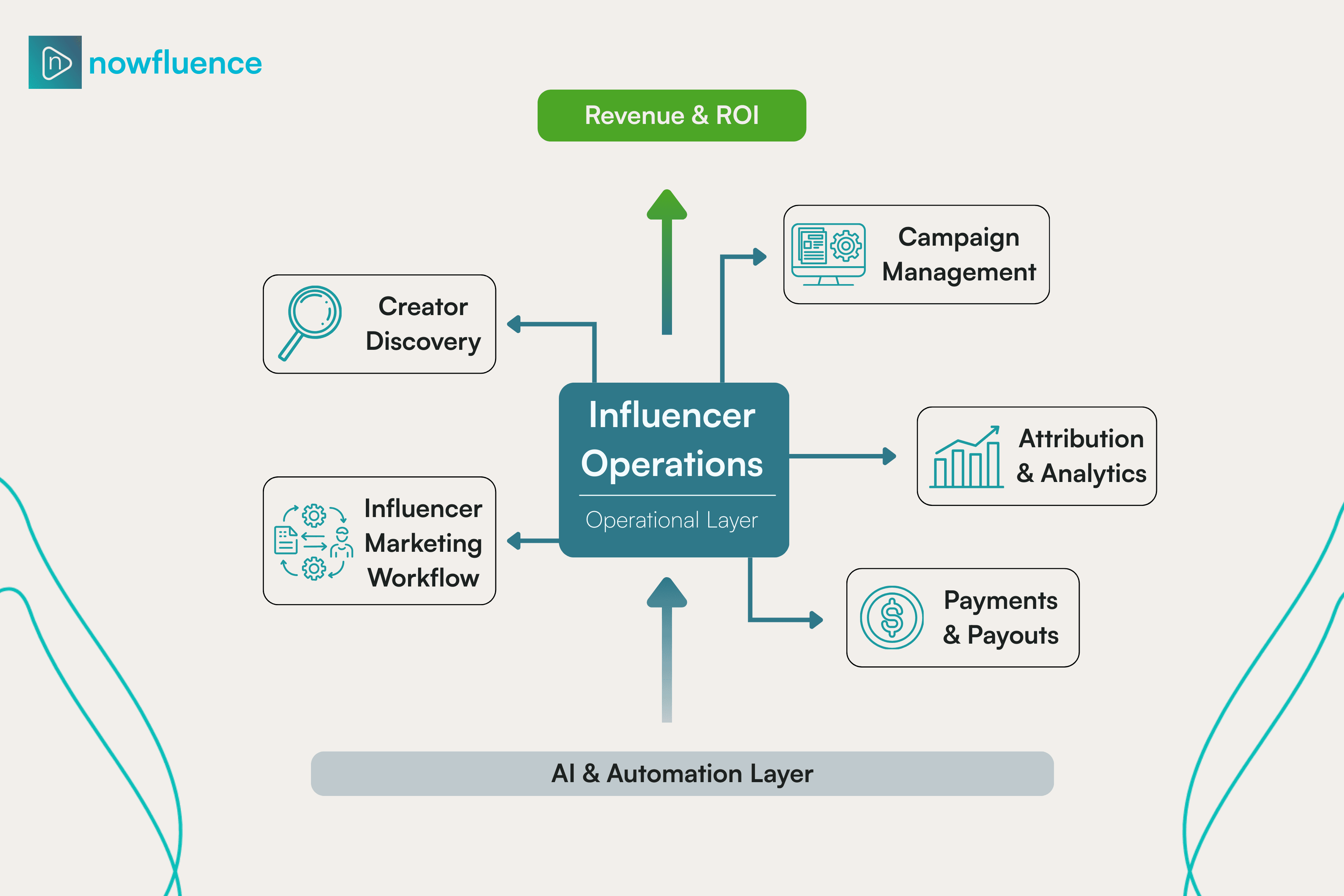
Data as the Foundation of Influencer Operations
Another critical insight from academic research is the importance of real time, reproducible data.
More than 70 percent of influencer marketing studies analyzed in the literature rely on unavailable datasets, making benchmarking and long term measurement nearly impossible. This lack of transparency mirrors the operational reality brands face when relying on self reported or gated creator data.
Modern influencer operations systems address this by analyzing real time public creator data across Instagram, TikTok, and YouTube, without requiring creators to onboard or connect accounts. When combined with direct ecommerce attribution, influencer marketing becomes measurable in the same way as other performance channels.
This approach aligns with the framework discussed in Why Every Shopify Brand Needs an AI Attribution Layer, where influencer performance is evaluated through real commerce outcomes rather than proxy metrics.
Influencer Operations as a Category
Categories shape how markets think:
- RevOps redefined how SaaS teams measure growth.
- Product Operations redefined how organizations scale development.
Influencer Operations reframes influencer marketing as an operational discipline rather than a creative experiment.
A second academic paper in computational marketing reinforces this idea by showing that AI models deliver the most value when embedded within structured workflows and feedback loops, not when used as isolated tools. AI becomes effective only when paired with governance, attribution, and performance visibility.
This is the same evolution described in From Creator Platforms to AI Operating Systems: The Next Evolution of Influence, where influencer marketing shifts from tools to systems.
The Future of Influencer Marketing Is Operational
The signals are consistent across research and market activity:
- Academic studies reveal structural gaps in influencer execution.
- Investor behavior shows automation is now expected.
- Brands demand speed, transparency, and measurable ROI.
Influencer Operations is the missing layer that connects these forces.
For modern marketing teams, this means moving from manual coordination to operational systems. For leadership, it means treating influencer marketing as a true performance channel. And for the industry, it means a new category is taking shape.
Influencer marketing is no longer about managing creators.
It is about managing operations.
Want to discuss insights from this study? Reach out to our research team.