Influencer Marketing as a Revenue Channel for Shopify Brands
Discover how Shopify influencer sales are transforming influencer marketing into a measurable revenue channel through verified data, AI attribution, and performance commerce.
December 15, 2025
For years, influencer marketing was treated as a brand awareness play. Likes, reach, impressions, and vague engagement metrics dominated reporting. But for Shopify brands operating in a performance driven ecommerce environment, that model no longer holds.
Today, influencer marketing is evolving into something far more powerful: a revenue channel.
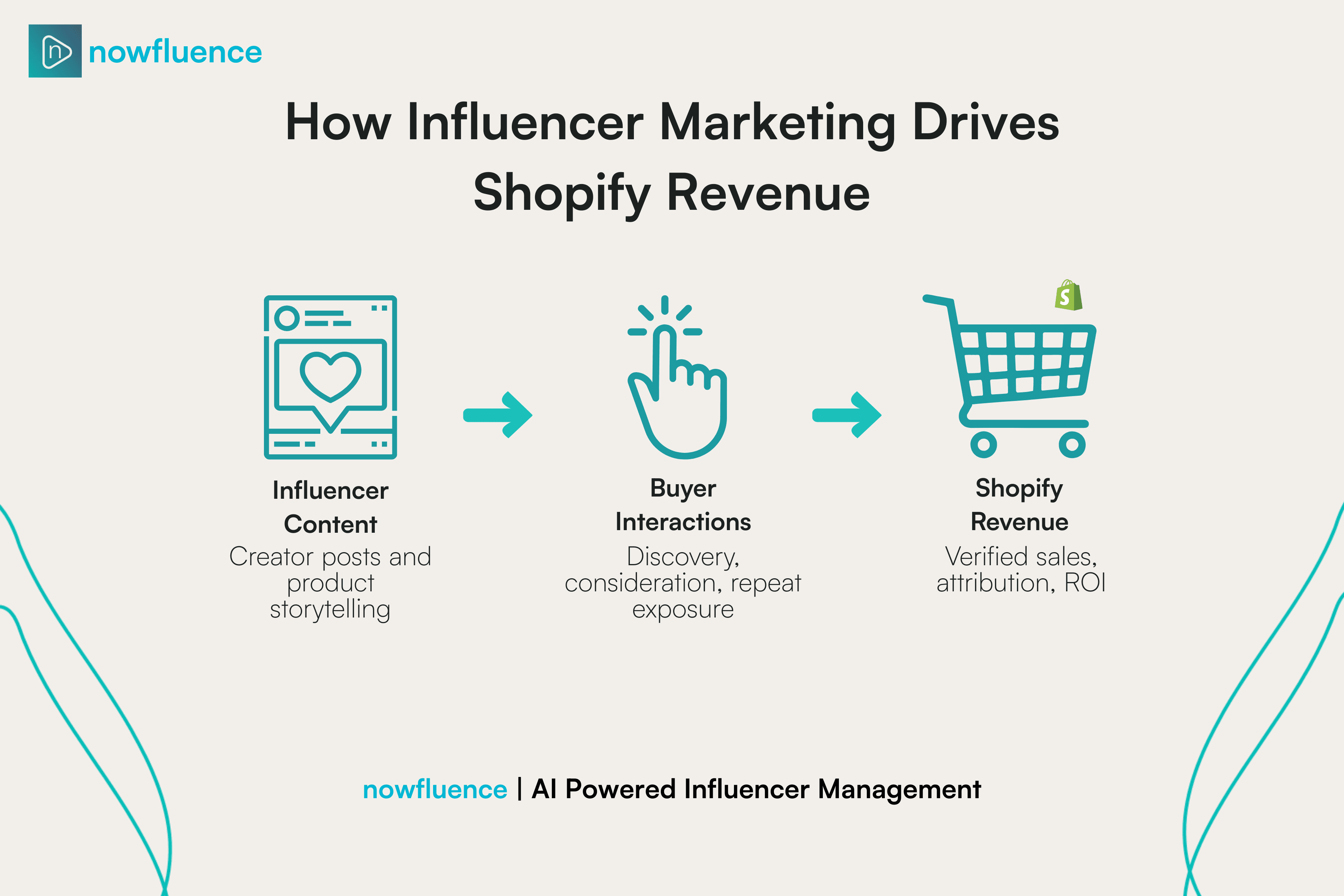
Driven by ecommerce integration, verified creator data, and AI powered attribution, Shopify influencer sales are becoming measurable, predictable, and scalable. Influencer marketing is no longer about exposure. It is about conversion.
From Awareness to Revenue Attribution
Shopify brands are uniquely positioned to transform influencer marketing into a sales engine because of their direct access to transactional data. When influencer campaigns connect to storefront activity, brands can move beyond assumptions and see what actually converts.
Recent industry research shows that ecommerce brands increasingly prioritize influencer marketing not as a creative experiment, but as a growth channel tied directly to revenue. Studies highlight that influencer driven campaigns outperform traditional digital ads in ROI, particularly when creators produce native short form content that drives trust and purchase intent.
Yet the real shift happens when influencer activity is connected to real sales data rather than surface level engagement.
This transition mirrors what we previously explored in Why Every Shopify Brand Needs an AI Attribution Layer, where attribution moves beyond last click models and begins to reflect how influence actually drives purchasing decisions across touchpoints.
Why Shopify Influencer Sales Are Accelerating
Several structural factors are pushing influencer marketing into a revenue focused role for Shopify brands.
First, consumer behavior has changed. Buyers increasingly discover products through creators they trust rather than through ads. Social platforms have become storefronts, and creators act as decentralized sales channels.
Second, Shopify’s ecosystem allows for seamless integration between content, traffic, and checkout. When influencer links, discount codes, and referral traffic connect directly to storefront analytics, performance becomes measurable.
Third, brands are demanding accountability. Marketing budgets are shifting away from channels that cannot prove ROI. Influencer marketing must now answer the same question as paid media: how much revenue did this generate?
This is why performance focused frameworks such as Multi Touch Influence: AI Attribution Beyond Last Click are becoming essential. Influence rarely converts in a single step. Attribution needs to reflect the full buyer journey.
The Role of Verified Data in Revenue Driven Campaigns
One of the biggest obstacles to treating influencer marketing as a sales channel has always been data trust.
Self reported metrics, inflated follower counts, and manipulated engagement distort decision making. When brands cannot trust the inputs, revenue projections fail.
Verified influencer data changes this equation.
By sourcing metrics directly from platform APIs, brands gain access to authentic audience demographics, reach, engagement, and historical performance. This allows Shopify brands to evaluate creators not on perceived popularity, but on their ability to drive conversions within relevant buyer segments.
This aligns closely with the thesis explored in The Hidden Cost of Non Verified Metrics: Why Brands Are Losing Money, where unreliable data directly translates into wasted spend and missed revenue opportunities.
When creators are vetted through verified data, influencer marketing begins to resemble other predictable acquisition channels.
Influencer Marketing as Performance Commerce
The future of Shopify influencer sales lies in what can be called performance commerce.
In this model, creators are not treated as media placements, but as performance partners. Campaigns are structured around outcomes, not exposure. Deliverables are tied to measurable goals. Payments are aligned with verified performance.
AI powered platforms enable this shift by automating creator discovery, campaign management, attribution modeling, and payout logic. Instead of manually coordinating dozens of creators and spreadsheets, brands operate influencer marketing like an operating system.
This transformation allows influencer programs to scale without operational chaos, while maintaining clear visibility into revenue impact.
How Shopify Brands Should Think About Influencers Going Forward
To unlock influencer marketing as a revenue channel, Shopify brands need to rethink how they structure their programs.
Influencers should be selected based on audience alignment and historical performance, not follower count. Campaign success should be measured by attributed revenue, conversion rate, and customer lifetime value, not vanity metrics. Payments should be automated, transparent, and tied to verified outcomes.
Most importantly, influencer marketing should be integrated into the broader ecommerce stack, not operated as a standalone experiment.
This strategic shift reflects a broader industry movement toward AI driven decision making, where creators, data, and commerce converge into a single system.
Influencer Marketing Is No Longer Experimental
For Shopify brands, influencer marketing has crossed a threshold.
What was once considered an awareness channel is now a measurable, optimizable, and scalable revenue driver. With the right infrastructure, Shopify influencer sales can rival paid media as a growth engine, while benefiting from higher trust and stronger customer relationships.
Influencer marketing is no longer about guessing what works. It is about building a system that proves it.
Want to discuss insights from this study? Reach out to our research team.