The Conversion Content Formula: How AI Identifies What Makes People Buy
Discover how AI analyzes content formats, emotional triggers, and creator performance to predict conversions before campaigns launch. Learn the data-driven formula behind high-converting influencer content.
November 24, 2025
In the new era of performance-driven influence, one truth is becoming impossible to ignore. The content that converts is not a mystery. It follows patterns that AI can now see with remarkable clarity. As machine learning models analyze thousands of videos, captions, sounds and audience behaviors, they are revealing the creative decisions that consistently drive people to purchase.
For Shopify brands, agencies and creators operating in 2025, understanding these conversion triggers is no longer optional. It is the foundation of predictable revenue through influencers. And at the center of this shift is the ability to merge creativity with data, allowing AI to identify which formats, messages and emotional cues transform a simple piece of content into a measurable sales engine.
This article combines insights from Hobo Video’s 2025 content format research, Data Intelo’s analysis of the AI content performance market, and ReelMind’s exploration of influencer conversion analytics to break down the conversion content formula. It also shows how AI-powered operating systems like nowfluence turn these insights into practical, repeatable workflows for creators and Shopify brands.
Why AI Is Redefining Content Performance
For years, brands relied on surface-level indicators such as likes, comments and reach to guide their influencer strategies. These metrics are still useful, but they do not tell the real story. Conversion is now the leading indicator of performance. AI systems can evaluate the creative, emotional and structural elements that influence purchase intent and tie them directly to measurable sales outcomes.
Hobo Video’s 2025 study demonstrates that short-form videos outperform static images in almost every scenario, with creator style content driving up to four times more conversions than traditional branded videos. This is not because the format is inherently superior. It is because short-form videos better align with how audiences consume information and make buying decisions.
ReelMind’s research reinforces this by showing how AI tracks sentiment, attention patterns and post-click behavior to determine conversion probability. The shift from engagement analytics to conversion analytics is transforming how brands and creators think about content structure, audience psychology and campaign strategy.
Meanwhile, Data Intelo reports that the AI-driven influencer content analysis market is projected to grow at more than 20 percent CAGR through 2033. This growth makes it clear that brands are demanding more precise analytics, deeper insights into creator performance and tools that can identify what makes content truly convert.
This convergence of technology and creativity is what defines modern content performance. AI no longer observes outcomes. It predicts them.
The Core Elements of High-Converting Content
Across industries, formats and creator styles, AI consistently identifies several factors that correlate with higher conversion rates. These elements form the backbone of the conversion content formula.
Authenticity that reduces risk for buyers. Creator videos outperform because they feel trustworthy, unpolished and human. AI can detect visual and verbal markers of authenticity that influence purchasing behavior.
Narrative clarity in short form. High-converting content delivers value fast. Viewers understand the benefit, the experience and the result within seconds. This aligns with Hobo Video’s findings that short videos generate stronger click-through and purchase behavior across segments.
Emotionally aligned messaging. AI sentiment models show that content with clear emotional triggers performs significantly better. Excitement, relief, aspiration and novelty are among the most powerful conversion drivers.
Format selection by industry. Beauty converts best through close-up demos and before-and-after content. Tech converts through explainers and unboxings. Fashion relies heavily on try-on videos and styling sequences. Food and beverage benefits from preparation and tasting moments. AI can map these patterns automatically.
Clear and compelling calls to action. AI models reveal a strong link between explicit CTAs and higher conversion. Viewers respond when they know exactly what the next step is.
These elements do not replace creative originality. They guide it. The creators who combine intuition with data consistently produce content that sells.
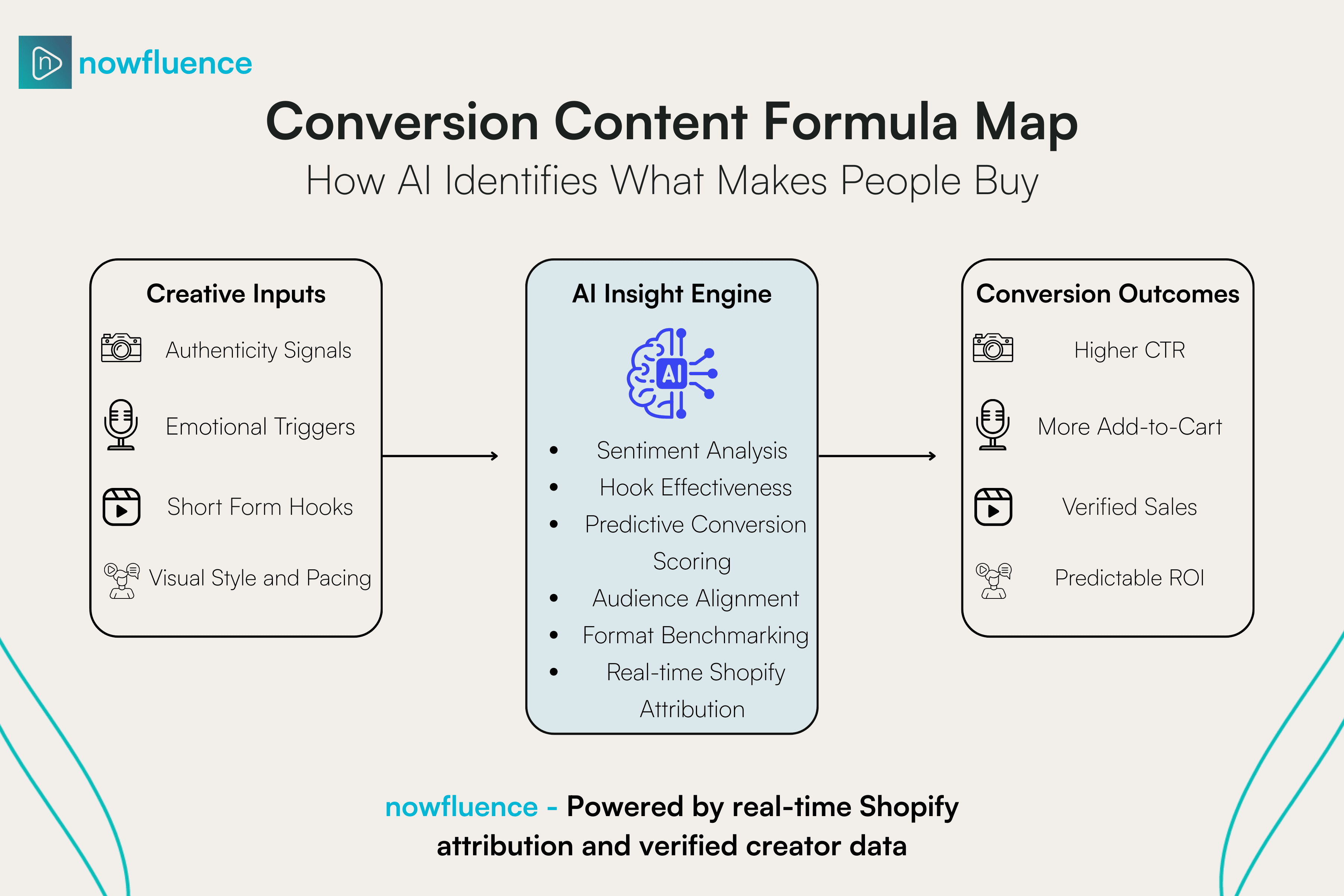
How AI Predicts Conversion Before a Campaign Begins
One of the most transformative developments in influencer marketing is the ability to forecast performance before a campaign is launched. This predictive capability is powered by three interconnected technological pillars.
AI content analysis models evaluate thousands of creative variables including pacing, sentiment, camera angles, audio style, product visibility, hook effectiveness and narrative arc. These elements are scored and correlated against historical conversion data.
Verified creator metrics ensure accuracy. With data sourced through APIs from Instagram, TikTok and YouTube, brands can trust that audience demographics, engagement quality and past performance are authentic. When combined with creative analysis, this produces highly reliable predictions.
Real-time attribution creates continuous improvement. Shopify-integrated tools can track conversions, clicks and revenue as they occur. These signals feed back into the AI model to refine predictions and optimize future content.
Within nowfluence, these three capabilities come together into a single AI-powered operating system. The platform analyzes content trends, evaluates which creators consistently produce high-performing formats and connects these insights directly to real-time sales attribution. This gives brands the ability to plan campaigns based on performance expectations rather than intuition.
If you have read our earlier articles such as The New Metrics of Influence: How AI Measures What Really Converts, you already understand how attribution and conversion metrics are reshaping influencer strategy. Our article From Likes to Revenue: How AI Turns Influencer Marketing Into Performance Commerce explores this shift in depth, and The Influencer Success Forecast: Predicting Sales Before Launch expands on how predictive analytics guides creator selection. These insights help contextualize the conversion content formula we explore here.
Creativity and Data: The New Partnership That Drives Sales
There is a misconception that AI diminishes creativity. In reality, AI enhances it. Data does not replace the creator’s intuition. It informs it. It provides clarity about which ideas have the highest probability of resonating, converting and generating consistent revenue.
The creators who excel in 2025 are those who use data as a partner. They test multiple formats, refine their storytelling, understand emotional patterns and lean into their strengths with precision. Brands that empower these creators with AI insights benefit from content that feels authentic, strategic and optimized for conversion.
This is the foundation of performance commerce. It is also the core of what nowfluence was built to enable. When creativity is amplified by verified data, predictive analytics and real-time attribution, influencer marketing evolves from a creative gamble into a measurable growth channel.
Final Thoughts
The future of influencer marketing belongs to brands and creators who understand the conversion content formula. AI makes it possible to identify the elements that persuade, the moments that motivate and the creative decisions that drive people to buy. Conversion is not random, and high-performing content is not accidental. It is intentional, structured and supported by intelligence.
As the market for AI-powered content analysis grows and attribution systems become standard for Shopify brands, the blend of creativity and data will define the next generation of influence. The brands that thrive will be those that adopt AI not as a replacement for creativity, but as a multiplier of it.
Creativity plus data equals content that sells. And in this new era, AI provides the roadmap.
Want to discuss insights from this study? Reach out to our research team.